
Interactive content makes visitors active participants — answering questions, choosing options, or exploring scenarios — so they spend more time, reveal intent, and move closer to conversion. This guide explains how interactive content works, why it usually outperforms static assets for lead generation, and how to plan, build, measure, and scale interactive experiences for B2B and SMB audiences. You’ll learn which interactive formats drive conversions, a practical roadmap for custom builds, measurable KPIs and benchmarks, and how to plug interactive assets into your current marketing stack. DIT Web Solutions Inc. can design and deploy custom interactive content as part of its web development and digital services; the guidance below shows how topic-first planning produces measurable results. Next, we define interactive content and contrast it with static approaches so you can see where each fits in your engagement strategy.
What is interactive content, and why it matters for engagement
Interactive content is any digital asset that asks for user input and returns immediate, relevant feedback — boosting focus and surfacing preferences. The idea is simple: turn passive readers into participants. That increases time on page, encourages completion, and captures first-party data that powers personalization and lead scoring. Those engagement signals become qualification signals for marketing and sales, directly improving conversion potential. With that distinction in mind, let’s compare interactive formats with static content to see where each approach belongs in your funnel.
How interactive content differs from static content
Unlike static assets that deliver one-way information (articles, PDFs), interactive content adapts to user input. Quizzes, calculators, and assessments require choices and return tailored outcomes, which drives deeper cognitive involvement. That difference typically shows up in better attention metrics — longer sessions and lower bounce rates — because users complete tasks rather than only read. For example, a gated whitepaper captures an email on download; a short assessment qualifies interest by score and feeds targeted follow-up.
Key business benefits of interactive content
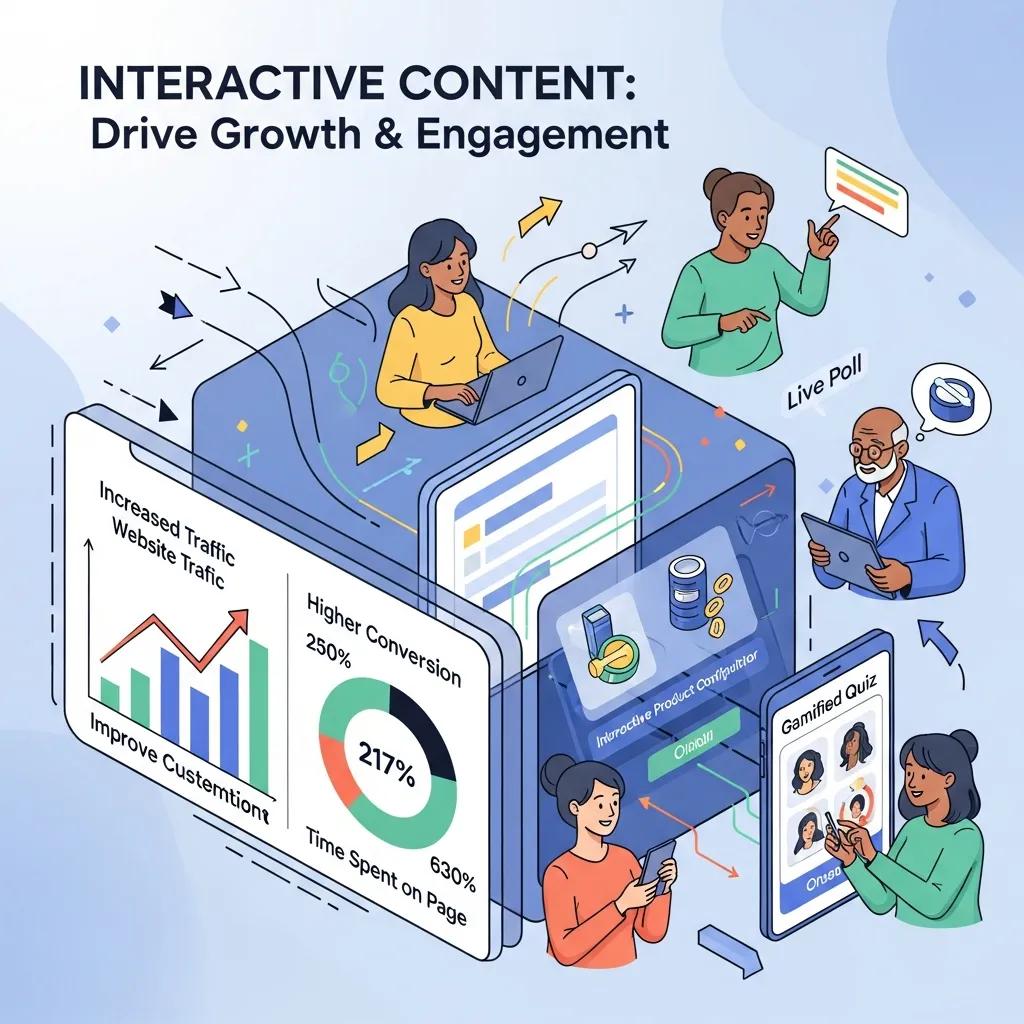
Interactive content delivers measurable business value across acquisition, qualification, and retention. First, it improves lead quality by revealing intent and preferences through responses and calculated results that feed CRM segmentation. Second, it accelerates decision-making — calculators and configurators surface clear value and shorten sales cycles. Third, interactive experiences are more shareable and drive engagement signals that help SEO. These benefits help teams prioritize formats that both engage users and generate first-party data for ongoing personalization.
Which types of interactive content drive leads and conversions?
Different interactive formats serve different conversion mechanics, so the right choice depends on audience, funnel stage, and integration needs. Top performers for lead generation include quizzes, polls, calculators, interactive video, infographics, and gamified experiences — each focused on qualification, insight, or decision support. In B2B and SMB settings, calculators and configurators often speed procurement decisions, while lead-generation quizzes help segment prospects for targeted nurture. DIT Web Solutions Inc. can build these formats and integrate them with CRMs and marketing automation so interaction data feeds nurture sequences and sales workflows.
Interactive content formats and one-line use cases:
- Quizzes: qualify leads and segment prospects for tailored nurture tracks.
- Polls/Surveys: collect quick audience insights to refine messaging and product direction.
- Calculators/Configurators: show ROI or pricing scenarios to lower purchase friction.
- Interactive Video/Infographics: improve retention and explain complex value props.
- Gamification: encourage repeat participation and raise lifetime engagement.
This list clarifies common use cases and sets up a comparison of how each format drives specific outcomes.
Intro to comparative table: The table below compares interactive types by primary use case and their typical impact on lead generation and conversion.
| Interactive Type | Primary Use Case | Lead / Conversion Impact |
|---|---|---|
| Quizzes & Assessments | Lead qualification and segmentation | Higher MQL rates via scored outcomes |
| Polls & Surveys | Audience insights and topical validation | Faster content optimization and targeting |
| Calculators & Configurators | Demonstrate ROI and pricing scenarios | Shorter sales cycles and higher demo requests |
| Interactive Video & Infographics | Explain complex value propositions | Improved retention and CTA engagement |
| Gamification | Drive repeat visits and loyalty | Increased retention and referral activity |
Use this comparison to prioritize experiments that match your conversion goals. Next, we’ll cover practical planning and design for B2B and SMB audiences.
How quizzes and assessments qualify leads effectively
Quizzes and assessments translate answers into interest signals and scored profiles that feed segmentation and follow-up. A focused quiz asks concise, decision-oriented questions that reveal pain points and readiness to buy, then delivers tailored advice or next steps tied to specific nurture tracks. Typical integrations push results into CRM fields and trigger automated workflows so sales can act on high-score leads with context. Example flow: user completes a 6-question assessment → score calculated → results page offers a gated CTA and creates an MQL tagged with topic preferences for targeted outreach.
The role of polls and surveys in gathering audience insights
Polls and surveys collect permissioned input that tests assumptions, surfaces priorities, and guides content or product decisions. Short embedded polls get high response rates for directional questions; longer surveys support segmentation when paired with incentives. Place them on high-traffic pages, in email, or on social to maximize responses. Then map answers to content updates, ad targeting, and segmentation rules in your marketing automation platform so feedback becomes action.
How calculators and configurators help buyers decide
Calculators and configurators turn abstract value into concrete numbers, easing uncertainty in complex or high-value B2B purchases. By modeling ROI, total cost of ownership, or pricing scenarios, these tools let prospects see the financial and operational impact before requesting a demo. Best practice captures minimal contact details for results, then routes qualified prospects to sales with a data-rich profile. Configurators also work as visual sales aids, letting buyers build options and get immediate quotes that speed procurement conversations.
Why use interactive video and infographics to improve retention?
Interactive video and infographics boost retention by embedding hotspots, branching paths, and inline checks that turn viewers into active learners. Branching video tailors demonstrations to viewer priorities; interactive infographics let users explore data layers at their pace, improving comprehension. These formats are ideal for product demos, onboarding, and nuanced thought leadership — they drive higher completion and stronger CTA performance than linear media.
How gamification increases loyalty and participation
Gamification applies reward mechanics — points, badges, leaderboards, milestones — to build repeatable engagement loops and deepen loyalty. When rewards tie to meaningful value (recognition, discounts, exclusive access), gamified experiences motivate ongoing interaction and advocacy. Measurable results include more frequent sessions, higher completion of learning paths, and increased sharing. Effective gamification aligns rewards with business goals so behavior changes matter, not just vanity metrics.
Interactive Content Marketing: Engaging Strategies for B2B and SMBs
A practical interactive content strategy maps formats to buyer journeys, technical constraints, and measurable outcomes through a repeatable process. Start with discovery to define goals and audience needs, then design experiences that balance simple UX with the right data capture and integrations. Build modular, instrumented assets that feed events to analytics and CRM, and optimize with A/B tests and event-level measurement to raise completion and conversion rates. This approach ensures interactive assets both engage users and deliver quantifiable value.
Key planning and design steps below form the backbone of any B2B or SMB implementation.
- Define goals and KPIs: list the business outcomes you expect from interactive assets.
- Map user journeys: identify touchpoints where interaction reduces friction or qualifies interest.
- Specify data flows: determine what fields populate CRM and how events trigger automation.
Use this checklist as an actionable starting point to move from idea to pilot.
Steps for planning and designing custom interactive content
Start with a discovery workshop to align objectives, audiences, and success metrics, then move to content mapping and prototyping. Design single-purpose interactions that ask the right question at the right time and keep cognitive load low for faster completion. Technical specs should define event names, CRM data schemas, and launch performance thresholds. Typical timelines include discovery, prototype, user testing, technical integration, and a staged roll-out to monitor early results and learnings.
How data-driven optimization improves performance
Optimization relies on event tracking, completion funnels, and A/B testing to refine questions, UI elements, and gating approaches. Track start rate, completion rate, drop-off points, and CTA conversions to spot friction and iterate quickly. Use captured responses to personalize follow-up and increase relevance. Continuous measurement helps teams prioritize the changes that move both engagement and conversion metrics.
Measurable benefits of interactive content marketing
Interactive content drives measurable uplifts in engagement and conversions by turning passive visits into active signals that feed qualification and personalization. Common gains include longer time on page, higher interaction rates, and clear conversion uplifts versus static content. To measure impact, focus on interaction events, completion metrics, and downstream attribution that links interactive behavior to MQLs and closed revenue. The next section lists common KPIs and how to track them.
Intro to KPI table: The table below lists key metrics, how to measure them, and expected benchmark ranges to evaluate interactive content performance.
| Metric | How Measured | Expected Benchmark Range |
|---|---|---|
| Interaction Rate | % of visitors who engage (click/answer) | 20% – 50% |
| Completion Rate | % of engaged users who finish the asset | 40% – 70% |
| Time on Page | Median seconds during interaction | 90 – 300 seconds |
| Lead Conversion Rate | % of interactions that become leads | 2% – 10% |
| CTA Click-Through Rate | % clicking follow-up CTA after completion | 10% – 30% |
These benchmarks give realistic targets for pilots and scale-up. Use them to prioritize optimizations and attribution work.
How interactive content lifts engagement and conversions
Interactive formats raise engagement by asking users to make choices, creating cognitive commitment and signaling intent — which boosts completion and CTA performance. Quizzes and calculators get users to weigh options rather than simply read claims, increasing perceived value and readiness to act. Benchmarks show interactive assets often produce higher completion and downstream conversion lifts when paired with targeted follow-up. That’s why interactive content is particularly effective for converting mid-funnel prospects.
What data businesses can collect for personalization
Interactive content captures zero- and first-party data — preferences, role, company size, scored needs, and calculated ROI — data that’s immediately actionable for personalization. Use it to power dynamic email content, tailored ad audiences, and sales outreach that references specific answers or calculated results. Respect privacy with clear consent and minimal required fields, and map collected data into CRM and automation fields so teams can trigger precise nurture and segmentation strategies.
How DIT Web Solutions Inc. helps implement custom interactive solutions
DIT Web Solutions Inc. takes a data-driven, tool-agnostic approach to designing and deploying interactive content aligned with client goals and tech stacks. Services span strategy, UX/UI design, development, and analytics integration so teams can move from discovery to measurement with one partner. DIT reduces project risk through validation, iterative builds, and clear success metrics, and integrates interactive assets with CRMs and marketing automation to make results actionable. For organizations that need a partner to deliver custom interactive experiences, DIT provides the technical and strategic capabilities to turn engagement into pipeline.
Intro to services table: Below is a mapping of DIT service components to deliverables and client benefits to show the practical value of partnering on interactive content projects.
| Service Component | Deliverable | Client Benefit |
|---|---|---|
| Strategy & Discovery | Requirements, KPIs, content map | Clear alignment with business goals |
| UX/UI Design | Prototypes, interaction flows | Higher completion and usability |
| Development & Integration | Instrumented builds, API/CRM hooks | Automated data flow and attribution |
| Analytics & Optimization | Event tracking, A/B tests | Continuous performance improvement |
This breakdown shows how DIT’s capabilities translate into outcomes that support lead generation and conversion. Below we detail specific services and the process that delivers predictable results.
What custom interactive content services DIT offers
DIT’s services include strategic planning, UX and interaction design, front-end and back-end development, and analytics instrumentation so interaction data is collected and attributed. Builds are tool-agnostic: DIT selects platforms or custom code based on scale and integration needs. Typical deliverables include prototypes, production-ready assets, CRM field mappings, and dashboards that track interaction events and conversion funnels. This mix lets clients deploy interactive content tied to measurable business KPIs without vendor lock-in.
How DIT’s process reduces risk and drives results
DIT follows a structured process — discovery, design, build, test, launch, optimize — that speeds learning and limits risk through staged validation and clear milestones. Discovery aligns stakeholders on objectives and data needs, design prototypes validate UX with users, and development ships instrumented assets that feed real-time analytics. Testing includes QA and A/B experiments before launch; post-launch optimization iterates based on event-level data and conversion outcomes. This disciplined method keeps projects focused on business outcomes and includes sign-offs at each phase.
How to get started with interactive content
Start smart: run a focused pilot, set clear KPIs, and keep integrations simple so you can prove value before scaling. Do a lightweight audit of content and analytics, pick one high-impact use case (like an ROI calculator or lead-qualifying quiz), and run a time-boxed pilot with measurable objectives. Include CRM and automation mapping, a promotion plan, and an optimization cadence for iterative improvements. These steps reduce risk and create early wins that justify broader investment.
Use this checklist to prepare for a discovery call and scope a pilot interactive project.
- Prepare goals and KPIs: define success in measurable terms.
- Identify target audience and funnel position: pick the segment and touchpoint.
- List technical constraints: current CRM, marketing automation, and analytics tools.
This checklist helps teams gather the information needed to speed scoping and quoting for interactive initiatives.
Next steps to request a consultation or quote
To request a consultation or quote, prepare a short brief outlining objectives, target audience, preferred interactive type, and your current technology stack. In the discovery call, expect to cover success metrics, timelines, and integration needs; the call typically results in a scoped proposal and phased plan with estimated deliverables. Framing the brief around a pilot goal — for example, increasing MQLs by a set percentage — helps vendors give realistic timelines and cost estimates. That preparation streamlines the proposal and keeps the initial scope aligned with measurable outcomes.
How to integrate interactive content with your marketing efforts
Connect interactive assets to landing pages, PPC and social campaigns, email nurture, and CRM segmentation so interaction data can be captured and acted on. Place assets at logical funnel stages — use awareness channels to drive quiz traffic, put calculators on product pages to capture intent, and embed polls in newsletters to refine segmentation. Instrument events and map names to automation triggers so completed interactions feed personalized follow-ups. Review attribution regularly and double down on channels that deliver the most qualified interactions.
Frequently asked questions
What are some best practices for creating interactive content?
Start by knowing your audience: what decisions they face and what information they need. Keep language clear and concise, design intuitive interactions, and minimize cognitive load. Offer immediate, useful feedback and test with real users before launch. Finally, promote your asset through the channels your audience uses to maximize reach and engagement.
How can businesses measure the success of their interactive content?
Measure interaction rate, completion rate, lead conversion rate, time on page, and CTA click-throughs. Use analytics to track start-to-finish funnels and attribute downstream conversions back to interactions. Regularly review these KPIs and use A/B tests to iterate on content and gating strategies.
What challenges might businesses face when implementing interactive content?
Common challenges include technical integration with existing systems, designing interactions that truly engage, and collecting quality data while respecting privacy. Creating high-quality interactive experiences often requires design and development expertise. Mitigate these risks by starting with a pilot, defining clear success metrics, and working with experienced partners.
How can interactive content enhance customer journey mapping?
Interactive content provides real-time signals about preferences and pain points, helping you refine personas and map decision paths more accurately. Quizzes, surveys, and calculators reveal where prospects are in their journey so you can tailor messaging and offers at each stage.
What role does personalization play in interactive content?
Personalization makes interactive experiences more relevant and valuable. Use responses and calculated outcomes to adapt follow-up content, email, and ads so each interaction feels tailored. When users see relevance, engagement and conversion rates improve.
Can interactive content be used for lead nurturing?
Absolutely. Interactive formats like assessments, quizzes, and personalized recommendations keep leads engaged and help qualify them over time. The data you collect fuels targeted nurture sequences that address specific needs and move prospects toward purchase.